Normal Testosterone Levels in Men
Author: Brian Hildebrandt, Last Updated: Sept. 3, 2019
Knowing the average testosterone level for your age can be useful. Once identified, it can help increase your odds of successful treatment.
Getting to optimal test levels can then help drive energy, strength, and motivation. But if low testosterone symptoms aren’t managed they can alternatively lead to a frustrating experience.
The following total and free T range indicates the downwards trend as men age.
Reference Ranges for Total and Free Testosterone Levels
| Vermeulen, A. (1996). Declining Androgens with Age: An Overview. In Vermeulen, A. & Oddens, & B.J. (Eds.), Androgens and the Aging Male (pp. 3-14). New York: Parthenon Publishing. |
| Age | Total Testosterone Average (ng/dl) | Free Testosterone Average (pg/ml) |
|---|---|---|
| 25 – 34 | 616 | 123 |
| 35 – 44 | 667 | 103 |
| 45 – 54 | 606 | 91 |
| 55 – 64 | 562 | 83 |
| 65 – 74 | 523 | 69 |
| 75 – 84 | 470 | 60 |
| 85 – 100 | 376 | 54 |
Unit Conversion Calculator
Total and Free Testosterone Levels by Age Chart
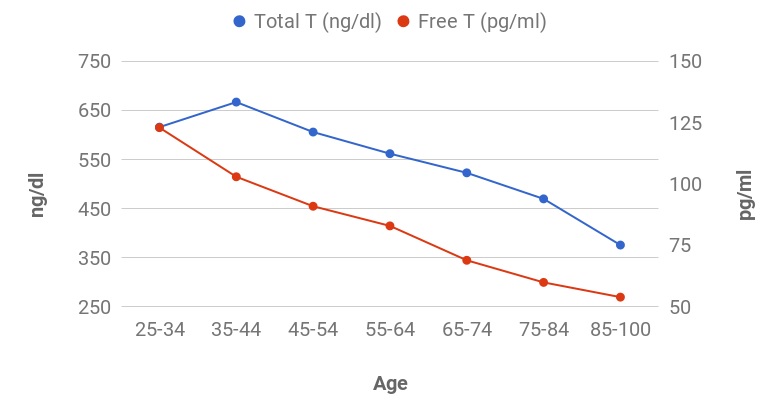
Average T Levels by Decade [3]
- 720 ng/dl for a man in his 30’s
- 667 ng/dl for a man in his 40’s
- 606 ng/dl for a man in his 50’s
- 562 ng/dl for a man in his 60’s
- 523 ng/dl for a man in his 70’s
Testosterone Levels in an Unhealthy Population
As you may imagine, these ranges are not set to optimal levels. They are from a cross-section of men aged 20 to 80. Many of whom may be sick or diseased, from a lifetime of unhealthy habits.
Upon receiving the results of your blood test, your T levels may be close or under the bottom of the range. If your doctor refuses treatment, a gentle reminder of what “optimal health” entails may be in order.
After pointing out, you have the T levels of a sick 80 year old hopefully, your doctor will come around.
Taking TRT if Having Symptoms of Low Testosterone
Courtesy of: Dr. Rand McClain
Emphasize your Low Male Hormone Symptoms
Perhaps your doctor is stubborn or doesn't like their patients being active participants in their own healthcare. In that case, you may be better off emphasizing your symptoms of low testosterone.
Noting a loss of sex drive, the development of impotence, and/or reduced muscle mass and strength is a start. That should give any knowledgeable doctor a red flag that T levels aren't on par.
Depression, fatigue, and loss of motivation are also commonly caused by low testosterone. Sadly, many doctors would rather prescribe an antidepressant. Bringing back to normal, a natural substance your body already makes, may be wiser.
Doctor Being Stubborn? Up the Ante to Ensure Treatment
If all else fails (as sad as it may seem), play the desperation/victim card. Maybe tell him you're on the cusp of getting fired, due to poor work performance.
Alternatively, you could share that your wife/girlfriend has threatened to leave. Saying they're dissatisfied over your sex drive/impotence problems or recent lack of ambition.
Most doctors with a soul will come around, once you explain the seriousness of your case. And if they don't, shop around. Sooner or later you'll find a doctor who's sympathetic, as tough as that search may be.
Check my resources section at the top of the page. It may help you find a highly rated doctor specializing in hormone replacement therapy in your area.