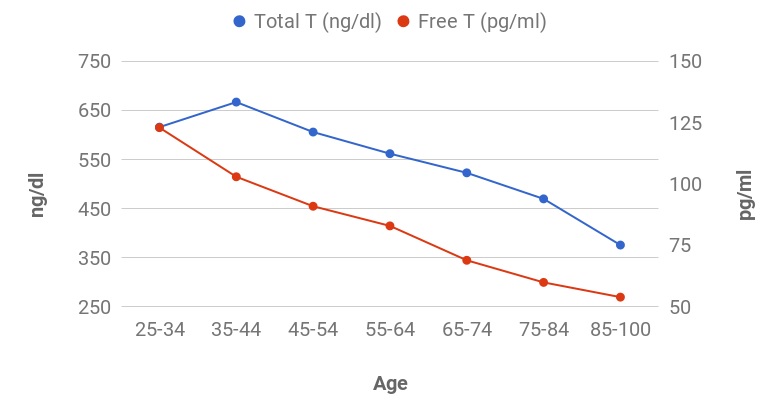
The range of normal testosterone levels in men can vary widely, and generally depends on such factors as; your doctor's interpretation of low testosterone symptoms and/or the lab used to examine your blood.
Additionally with age, your androgen levels may change, necessitating the need for testosterone replacement therapy to help maintain health.
This can be caused by; altered hormone profiles from common medications, general increases in stress, or other disease factors typically associated with hypogonadism.
Typically during youth (ages 14-20), free testosterone levels are at their highest.
However as men age, androgen levels generally diminish with time, resulting in less vigor, weakness, and impaired health profiles.
While testosterone's effects on strength and muscle mass are commonly known, awareness of it's impact on cardiovascular risk, depression, and impotence is unfortunately almost non-existant in most healthcare settings.
| Vermeulen, A. (1996). Declining Androgens with Age: An Overview. In Vermeulen, A. & Oddens, & B. J. (Eds.), Androgens and the Aging Male (pp. 3-14). New York: Parthenon Publishing. |
| Measurements in SI Units (nmol/L) |
| Age | Number of Subjects |
Total Test |
Stand. Dev. |
Free Test |
Stand. Dev. |
SHBG | Stand. Dev. |
|---|---|---|---|---|---|---|---|
25-34 |
45 |
21.38 |
5.90 |
0.428 |
0.098 |
35.5 |
8.8 |
35-44 |
22 |
23.14 |
7.36 |
0.356 |
0.043 |
40.1 |
7.9 |
45-54 |
23 |
21.02 |
7.37 |
0.314 |
0.075 |
44.6 |
8.2 |
55-64 |
43 |
19.49 |
6.75 |
0.288 |
0.073 |
45.5 |
8.8 |
65-74 |
47 |
18.15 |
6.83 |
0.239 |
0.078 |
48.7 |
14.2 |
75-84 |
48 |
16.32 |
5.85 |
0.207 |
0.081 |
51.0 |
22.7 |
85-100 |
21 |
13.05 |
4.63 |
0.186 |
0.080 |
65.9 |
22.8 |
| Measurements in Conventional Units (ng/dl), SHBG in (nmol/L) |
| Age | Number of Subjects |
Total Test |
Stand. Dev. |
Free Test |
Stand. Dev. |
SHBG | Stand. Dev. |
|---|---|---|---|---|---|---|---|
25-34 |
45 |
617 |
170 |
12.3 |
2.8 |
35.5 |
8.8 |
35-44 |
22 |
668 |
212 |
10.3 |
1.2 |
40.1 |
7.9 |
45-54 |
23 |
606 |
213 |
9.1 |
2.2 |
44.6 |
8.2 |
55-64 |
43 |
562 |
195 |
8.3 |
2.1 |
45.5 |
8.8 |
65-74 |
47 |
524 |
197 |
6.9 |
2.3 |
48.7 |
14.2 |
75-84 |
48 |
471 |
169 |
6.0 |
2.3 |
51.0 |
22.7 |
85-100 |
21 |
376 |
134 |
5.4 |
2.3 |
65.9 |
22.8 |
| Simon, D., Nahoul, K., & Charles M.A. (1996). Sex Hormones, Aging, Ethnicity and Insulin Sensivity in Men: An Overview of the TELECOM Study. In Vermeulen, A. & Oddens, and B. J. (Eds.), Androgens and the Aging Male (pp. 85-102). New York: Parthenon Publishing. |
| Measurements in SI Units (nmol/L) |
| Age | Number of Subjects |
Mean Total Test |
Stand. Dev. |
Median Total Test |
5th % | 10th % | 95th % |
|---|---|---|---|---|---|---|---|
<25 |
125 |
23.97 |
5.48 |
24.15 |
14.15 |
16.22 |
33.12 |
25-29 |
354 |
23.18 |
7.14 |
22.08 |
13.46 |
15.18 |
34.84 |
30-34 |
330 |
21.53 |
6.72 |
20.70 |
12.07 |
13.46 |
33.81 |
35-39 |
212 |
20.70 |
6.55 |
19.66 |
11.39 |
13.46 |
32.77 |
40-44 |
148 |
20.70 |
6.87 |
20.70 |
11.04 |
13.11 |
32.43 |
45-49 |
154 |
18.91 |
5.66 |
18.28 |
11.39 |
12.42 |
29.32 |
50-54 |
164 |
18.87 |
6.49 |
17.94 |
10.01 |
12.07 |
32.43 |
55-59 |
155 |
19.14 |
6.04 |
18.97 |
11.04 |
11.73 |
30.01 |
| Measurements in Conventional Units (ng/dl) |
| Age | Number of Subjects |
Mean Total Test |
Stand. Dev. |
Median Total Test |
5th % | 10th % | 95th % |
|---|---|---|---|---|---|---|---|
<25 |
125 |
692 |
158 |
697 |
408 |
468 |
956 |
25-29 |
354 |
669 |
206 |
637 |
388 |
438 |
1005 |
30-34 |
330 |
621 |
194 |
597 |
348 |
388 |
975 |
35-39 |
212 |
597 |
189 |
567 |
329 |
388 |
945 |
40-44 |
148 |
597 |
198 |
597 |
319 |
378 |
936 |
45-49 |
154 |
546 |
163 |
527 |
329 |
358 |
846 |
50-54 |
164 |
544 |
187 |
518 |
289 |
348 |
936 |
55-59 |
155 |
552 |
174 |
547 |
319 |
338 |
866 |
Your normal testosterone range may change, depending on the lab your blood work is processed. For statistical purposes, typical male testosterone levels range between 250ng/dl to 850 ng/dl.
But... this is not necessarily a healthy range! Reference ranges aren't typically set by what is healthy and what is not. They are set by where 95% of the population lies.
Do you honestly believe 95% of the population is healthy? Unfortunately many doctors fall prey to this line of thinking.
These ranges aren't set for men interested in living a virile, energetic, ambitious quality of life. They are a cross section of men aged 20 to 100... many of them are sick and diseased.
Often I hear from men discussing their doctor's refusal of treatment, due to testosterone readings of ~275 ng/dl, and being told they're "within range".
If this sounds familiar, you have a couple of options. You can print off the above chart (with the supporting journal reference) and bluntly tell your doctor you have the testosterone level of an average 90 year old, and hope he/she may come around.
Better yet... you may be better off detailing your low testosterone symptoms in men such as; loss of sex drive and concentration, depression, fatigue, etc...
Sometimes you may have to pull the heart strings a little. Tell him your work performance/income is suffering and you're worried about getting fired, or your wife/girlfriend is talking about leaving you due to motivation and/or libido problems.
This may sound manipulative, but sometimes with doctors desperation can get you places. Most will feel sorry for you, and rightfully so!
Doctors will usually come around once you explain the seriousness of your case. And if they don't... shop around.
Life extension clinics are much more likely to shoot towards the top of the reference range for serum testosterone levels. They're generally a more enlightened bunch that get what quality of life is about, and what's needed to get there.
Osteopaths I would consider second best for the administration of proper testosterone treatment, with urologists and endocrinologists third, behind your general practitioner (family doctor).
But sometimes it's a crapshoot... you get lucky, or have to go through some trial and error.
A reader asks...
I had my testosterone tested and the doctor says my serum level is 390 ng/dl, which he advises is within range. I had a look at your charts and it says my testosterone levels appear normal for an 85 to 100 year old???
I am 48 years old and have type 2 diabetes, if that makes a difference. Therefore, the question I'm asking is: Are my T levels normal for a 48 year old male?
Response,
What your doctor is referencing is the range (95% of the population) for a human male (aged 20-100). Everyone gets the same range, regardless of their age. So yes, you fit within that wide range.
However, research shows you have the free testosterone levels of an average 85 to 100 year old man, or otherwise interpreted; close to the bottom 10% of men aged 45-49. Meaning 90% of the men your age have higher testosterone levels!
According to the above charts, the average man aged 45-54 has testosterone levels around 606 ng/dl. So as you can see, 390 ng/dl is well under the mark.
With feedback from of a large cross section of men I've heard from over the years, most feel best with testosterone levels close to the average 25 year old, which is approximately 692 ng/dl.
This is what's considered, by some more forward thinking doctors, as "optimal" for physical, mental, and emotional health.
Hope that helps,
Brian
Home > Testosterone Levels > Normal Testosterone Levels in Men